Blog
Hello everyone !
Today Mr and Mrs Ry Bird Space have a son, what do they call him?
Last week Mr. and Mrs. Cor had a son called Tex, Cortex.
Good day and good game ;)

Hello everyone ! I hope you had a good weekend !
Today we are going to play with the word “last”.
I'm going to sing "Last chance for love tonight" and you?
Good day and good game ;)
In JJV's Offs
Hello everyone !
Welcome to a new opus of “JJV Offs”!
The last will be first !
As Mika Hakkinen says, “To be a good winner, you have to be a good loser.” »
When you are passionate about what you do, you fall much more often than you rise. What would be a shame would be not to get up after falling...
Because to be better than you were before, you have to know how to fall, lose, start again, fall again, lose, and always get back up to win small victories day after day.
The first were not always first, they progressed, tested, failed, tried again and finally got there.
After covid, I was unable to restart in-store events, but outdoor events resumed even better than before thanks to my determination.
If we start telling ourselves that we are going to lose or not succeed, we will only have a greater chance of losing if we think about trying and trying again until we manage to do something...
When I started some outdoor events, I didn't think I could do it because it was a whole new style of audience.
And then, I put an action plan in place with small concrete actions to carry out to achieve other, larger actions.
I even almost stopped certain activities for fear of not living up to the expectations we had from playtime...
And then if a goal scares us, it’s because we’ve set the bar high enough and we’re on the right track to get out of our comfort zone and develop our goals.
So I worked twice as hard on what was causing me difficulty in order to be able to meet the demands that were asked of me during these play times.
And today, I am very happy that I didn't give up and didn't give up, because I gained more experience and development from the store's playtime...
It’s often on the other side of your comfort zone that you make the best progress!
If your goals scare you, it’s because they take you out of your comfort zone, but you will see that if you do it, you will end up thanking yourself!
A defeat is a victory, because it teaches us much more about ourselves than a victory. ;)
Good day and good game ;)
Hello everyone !
Our Play with thought of the day comes to us from Mika Hakkinen:
“To be a good winner, you have to be a good loser. »
Good day and good game ;)
In 2 words game
2 words game Cortex challenge 3
Hello everyone!
Today we are going to talk about Cortex!
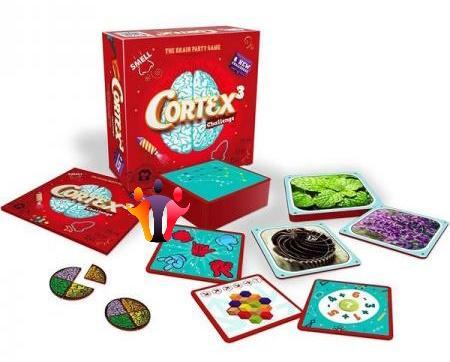
Who can rebuild their brain the fastest by taking on the logic challenges, from 2 to 6 players for 15 minutes from 8 years old!
In Cortex be the first to find the solution to four different logic puzzles to rewire your brain and win the game!
Place the test cards in a pile in the center of the table, then turn the first face up.
We will then try to find the answer to the riddle as quickly as possible by putting our hand on the card as soon as we think we have found it.
We then give the answer by showing the card and once verified if the answer is correct, the player wins a card which he places in front of him.
Each player can only have 4 cards in front of him, he will have to discard any if he has more or exchange two identical cards (same back) for a piece of puzzle brain.
If he made a mistake, the card is discarded and a new challenge card is turned over to start a new challenge.
The challenges are made up of 8 different types of challenges:
- The orientation where we will leave from the starting point and find our way to arrive at the place indicated by the arrows.
- The color sequence where we start from the image surrounded by a red circle then we rely on the background color of the animal to find the next animal, then the next, etc.
- The intruder where you have to find the different shape among three shapes.
- The fusioform where we find which shapes made up the main form.
- Constellation where we find the constellation containing the most stars.
- Coordination where we must either with the left hand (blue symbol) or the right (red symbol) beat the sign surrounded by a red shifumi circle.
- Calculation where you must give the result of the calculation starting from a number in red.
- Olfactory challenge where you rub the card face down and try to find the smell hidden behind it. Only the player who won the last card completes this challenge.
The game ends as soon as a player has completed the four pieces of their brain puzzle.
Good day and good game ;)


Hello everyone !
My 1st is the 1st syllable of corporate.
My 2nd is Avery’s name
My whole is a reflexion game when you’ll need concentration , who am I?
Good day and good game ;)

Hello everyone !
The crown of Olympic heroes!
From the Seventh Olympiad (752 BC), the Olympic champion receives a wild olive wreath, a palm branch and a red woolen ribbon called the tænia.
Initially reserved only for wealthy male Greek citizens, the Games led to an Olympic truce.
The latter does not stop conflicts, but allows athletes and spectators to freely cross war zones without being worried.
The significance of an Olympic title is considerable. The champions are authentic folk heroes and are showered with gifts and honors upon their return to their city.
They have been fully professional since the 5th century BC. AD and can decide to defend the colors of another city.
These changes of allegiance often cause unrest, sometimes significant, in the “betrayed” city.
We can thus cite the case of Astylos of Crotone (6 Olympic titles), who moved from Crotone to Syracuse in 484 BC. BC, causing serious unrest in Crotone.
Good day and good game ;)